
OEM/ODM Jewelry Manufacturing Risk: What the NDA Covers
A 100% NDA protects a narrow, specific set of things: the moulds, the CAD files and the collection itself are not resold or shown to other buyers. It does not protect the schedule, the minimum order or the finish. TTT Jewelry publishes a 25–30 day sampling window and a 50-piece silver floor, and those two numbers carry as much commercial risk as any design leak.
Key takeaways
- Exclusivity covers moulds, CAD and the collection, which are not resold or shown.
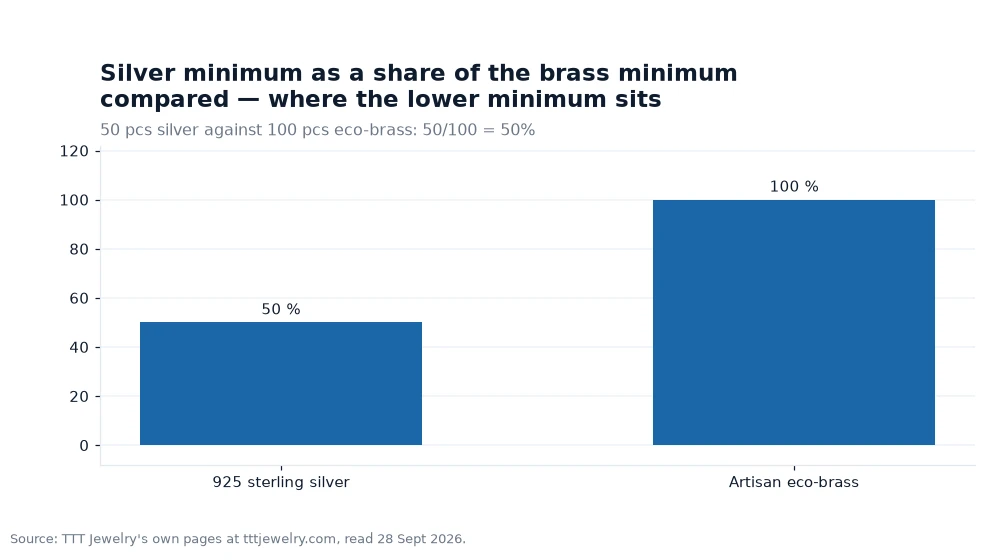
- The silver floor of 50 pieces per design is 50% of the brass floor of 100.
- Sampling at 25–30 days plus production at 21–28 days gives 48–60 days.
- A missed sample round adds 25–30 days, which the NDA does nothing to prevent.
What the confidentiality clause names
The published wording is that designs are 100% exclusive to the brand, with a 100% NDA, and that moulds, CAD and the collection are not resold or shown. Those are three concrete assets rather than a general promise of secrecy.
Naming the assets matters because it tells a buyer what can be enforced. A mould is a physical object that either exists in one factory or does not. A CAD file is a document with a revision history. A collection is a set of designs that either appears in another catalogue or stays out of it.
The clause is strongest on the mould, because tooling is hard to copy without the original. It is weaker on a silhouette that can be redrawn from a photograph, which is why design registration sits alongside confidentiality rather than inside it.
Ownership changes between the models
In OEM the buyer supplies the CAD, and the IP is published as 100% buyer-owned. The factory's obligation is to build to the file and keep it out of other hands.
In ODM the factory develops the concept, and the published promise is a co-created collection that stays exclusive to the brand. The buyer does not own the development process, but does own the exclusive right to the resulting range.
The distinction decides what happens if the relationship ends. An OEM buyer can take the file to another supplier, subject to tooling arrangements. An ODM buyer usually cannot take the development file, because the design work belongs to the party that did it.
Both positions are workable, but they need to be understood before the first sketch. A brand that assumes it will own an ODM file is negotiating from a misunderstanding.
Buyers comparing ODM jewelry production services should ask for the ownership wording inside the quotation, not only in a separate confidentiality document. The two are normally signed together, and the ownership line decides what the brand can take with it if the relationship changes.
The risks the NDA does not touch
Three operational exposures sit outside confidentiality. The first is time: a sample that arrives late pushes the launch, and no clause recovers a season. The second is quantity: the per-design minimum is a commitment whether or not the design sells.
The third is compliance. Plating is published as 100% compliant with REACH and CA Prop 65, and materials are free of lead, cadmium and nickel. A buyer still needs the statement to cover the specific finish ordered, not just the base metal.
A fourth exposure is often forgotten: packaging. A logo tag, a foil-stamped box or a barcode label can hold up a finished order at the packing table even when every piece has passed QC.
A quality system certified to ISO 9001:2015 gives the buyer a way to audit those stages instead of taking them on trust, because the standard asks for control records across production rather than a single final check.
| Exposure | Where it is addressed | Published figure |
|---|---|---|
| Design copied or shown | NDA and exclusivity terms | 100% exclusive |
| Launch slips | Sampling and production schedule | 25–30 days, then 21–28 |
| Stock committed | Per-design minimum | 50 silver, 100 brass, 100+ stainless |
| Material compliance | REACH and CA Prop 65 statements | Lead, cadmium, nickel free |
| Order held at packing | Packaging specification | Five retail extras |
Only the first row is contractual secrecy. The other four are planning problems with published numbers attached.
Why the silver floor is half the brass floor
Silver starts at 50 pieces per design; brass starts at 100. The ratio is 50/100 = 50%, so a silver test locks up half the stock of the same design in brass.
That difference is a risk instrument. A brand testing an unproven shape can do it in silver for 50 units, then move the winner into brass at 100 once demand is visible. Doing the test in brass first doubles the exposure on a design nobody has bought yet.
The material choice also changes the finish route. Silver and brass take electroplating with an anti-tarnish e-coating; stainless takes PVD vacuum plating at a 100+ floor. Each route has its own minimum, so the material decision is also a commitment decision.
Worked example
A brand plans three designs in brass. At the published floor the order is 3 × 100 = 300 pieces. The same three designs in silver are 3 × 50 = 150 pieces, so the material choice halves the commitment by 150 units.
If the range fails, the difference is 150 pieces of unsold stock. If it succeeds, the brass version carries twice the depth on the same shapes, which is an advantage for a reorder. The floor does not decide which is right; it makes the size of the bet visible.
The calendar is separate. CAD at 2 days, sampling at 25–30 days and production at 21–28 days total 48–60 days. One missed sample round pushes the total to 73–90 days, which is more than ten weeks.
Inspection is the fourth number. With 100% final QC, a 300-piece brass run produces 300 checked pieces. A fault found at the last gate is a fault on the whole run, not on a sample of it.
Frequently asked questions
Does a 100% NDA stop a factory from showing the design?
It commits the factory to keep the moulds, CAD and collection out of other buyers' hands; the published term is that designs stay 100% exclusive to the brand and are not resold or shown.
Who owns the CAD in an ODM project?
In OEM the buyer owns the file and the IP. In ODM the development is co-created, and the collection is kept exclusive to the brand rather than resold.
What protects the schedule if sampling runs late?
The NDA does not. Protection comes from written dates for the 48-hour CAD stage and the 25–30 day sample, with a defined point at which the buyer can revise or cancel.
Writing risk into the order
The useful move is to separate the confidentiality terms from the commercial ones and negotiate both in the same document. A buyer who only reads the NDA has reviewed one of five exposures.
Set the design count against the floor, then set the approval date against the sample window. The TTT Jewelry process publishes both figures, which makes the trade-off explicit rather than anecdotal.
Where the range is likely to grow, the custom jewelry wholesale structure is the natural second step, because reorders reuse existing moulds and do not repeat the development risk.
Confidentiality protects the design. The numbers protect the business, and they are published for anyone who asks for them.
Source note: figures come from the manufacturer's own website (tttjewelry.com), read 28 Sept 2026.[1]